The Subtext in a Work of Art Refers to
Types of Content
Content in art takes the grade of portraits, landscapes, still-lifes, genre art, and narrative art.
Learning Objectives
Describe different categories of figurative or abstract art.
Key Takeaways
Cardinal Points
- Content in a work of art refers to what is being depicted and might exist helpful in deriving a bones meaning. It appears in the visual arts in several forms , all of which may be figurative (realistic) or abstract (distorted). Among them are portraits, landscapes, still-lifes, genre art, and narrative art.
- Portraits represents the likeness of a person and tin can include a study of the sitter's mood or personality.
- Landscapes depict natural scenery such as mountains, valleys, trees, rivers, and forests, especially where the chief discipline is a wide view.
- A withal-life is a work of art depicting mostly inanimate subject thing, typically commonplace objects that may be either natural or human being-made.
- Genre art involves the pictorial representation in whatever of various media of scenes or events from everyday life, whereas narrative art tells a story that may be real or imagined.
Content in a work of art refers to what is being depicted and might exist helpful in deriving a basic meaning. Sometimes content is straightforward; in other cases, withal, it is less obvious and requires additional information. Content appears in the visual arts in several forms, all of which may be figurative (realistic) or abstract (distorted). Among them are portraits, landscapes, still-lifes, genre art, and narrative fine art.
Portraits
A portrait is a painting, photograph, sculpture, or other artistic representation of a person, in which the face and its expression are predominant. The intent is to display the likeness, personality, and fifty-fifty the mood of the person. For this reason, in photography a portrait is generally not a snapshot, merely a composed image of a person in a even so position. A portrait frequently shows a person looking directly at the painter or photographer in guild to virtually successfully appoint the subject with the viewer .

Philip Burne–Jones Belongings a Cat : George Grantham Bain Collection, Library of Congress, Washington, DC.
Landscapes
Landscape painting, also known as landscape art, is the depiction in art of landscapes—natural scenery such as mountains, valleys, copse, rivers, and forests, peculiarly where the main subject is a wide view—with its elements arranged into a coherent composition . In other works, landscape backgrounds for figures can nevertheless form an important office of the work. Sky is almost ever included in the view, and weather is often an element of the composition. Detailed landscapes as a distinct subject are not institute in all creative traditions and develop when there is already a sophisticated tradition of representing other subjects.

Henri Matisse. Landscape at Collioure (1905): Oil on canvas. 38.8 x 46.6cm. Museum of Modern Art, New York. Matisse was a fellow member of the Fauves (French for "wild beasts"), who used bold colors to convey emotions.
Still Lifes
A yet life (plural still lifes) is a work of art depicting generally inanimate bailiwick matter, typically commonplace objects that may be either natural (nutrient, flowers, dead animals, plants, rocks, or shells) or human-made (drinking glasses, books, vases, jewelry, coins, pipes, and so on). Early still-life paintings, specially before 1700, often contained religious and allegorical symbolism relating to the objects depicted. Some modern still lifes break the two-dimensional bulwark and employ iii-dimensional mixed media, and use found objects, photography, computer graphics, every bit well as video and sound.

Maria van Oosterwijk. Vanitas Still-Life (1668): Oil on canvas. 73 x 88.5cm. Kunsthistorisches Musuem, Vienna.
Genre Art
Genre art is the pictorial representation in any of diverse media of scenes or events from everyday life, such as markets, domestic settings, interiors, parties, inn scenes, and street scenes. Such representations (also called genre works, genre scenes , or genre views) may be realistic, imagined, or romanticized by the artist.

Nicolaes Maes. The Idle Servant (1655): Oil on canvas. National Gallery, London. Dutch Bizarre genre scenes often have important moral lessons as their subtexts.
Narrative Art
Narrative art is art that tells a story, either as a moment in an ongoing story or as a sequence of events unfolding over fourth dimension. Some of the earliest evidence of man art suggests that people told stories with pictures. However, without some noesis of the story being told, it is very hard to read ancient pictures considering they are not organized in a systematic way like words on a page, but rather can unfold in many unlike directions at one time.

Hagesandros, Athenedoros, and Polydoros. Laocoön and His Sons (Starting time century BCE): Marble. Vatican Museum, Rome. This marble sculpture depicts a scene from Virgil'due south ballsy The Aeneid, in which the Trojan seer Laocoön foresees the Trojan Horse and the destruction of Troy by the Greeks. Before he can warn his fellow townspeople, the sea god Neptune (an marry of the Greeks) sends his serpents to kill Laocoön and his sons.
Figurative and Abstract Art
Fine art exists forth a continuum from realistic representational piece of work to fully non-representational work.
Learning Objectives
Distinguish between figurative and abstract art
Fundamental Takeaways
Primal Points
- Representational fine art, or figurative fine art, references objects or events in the real earth.
- Romanticism , Impressionism , and Expressionism contributed to the emergence of abstruse art in the nineteenth century.
- Even representational work is abstracted to some degree; entirely realistic art is elusive.
Key Terms
- verisimilitude:The property of seeming truthful, of resembling reality; resemblance to reality, realism.
Painting and sculpture can be divided into the categories of figurative (or representational) and abstract (or non-representational). Figurative art describes artwork – particularly paintings and sculptures – which are conspicuously derived from real object sources, and therefore are, past definition, representational. Since the arrival of abstract fine art in the early twentieth century, the term "figurative" has been used to refer to whatsoever form of modern art that retains strong references to the real earth.
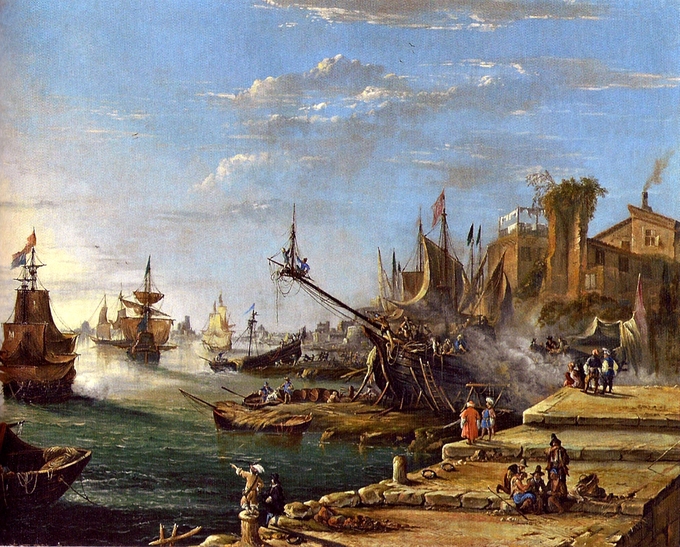
Johann Anton Eismann, Ein Meerhafen, 1600s: This figurative work from the 17th century depicts hands recognizable objects—ships, people, and buildings.
Artistic independence was advanced during the nineteenth century, resulting in the emergence of abstruse fine art. Three movements which contributed heavily to the development of these styles were Romanticism, Impressionism, and Expressionism.
Abstraction indicates a departure from reality in its depiction of imagery . Abstraction exists forth a continuum; it can formally refer to compositions that are derived (or abstracted) from figurative or other natural sources, or it can refer to non-representational art and not-objective art that has no derivation from figures or objects.
Even fine art that aims for verisimilitude of the highest caste tin be said to be abstract, at least theoretically, since perfect representation is likely to be exceedingly elusive. Artwork which takes liberties, altering, for instance, color and form in means that are conspicuous, tin be said to be partially abstruse.

Robert Delaunay, Le Premier Disque, 1912–1913: Delaunay'due south work is an instance of early abstract fine art.
Non-representational art refers to total abstraction, bearing no trace of any reference to annihilation recognizable. In geometric abstraction, for example, i is unlikely to find references to naturalistic entities. Figurative art and total abstraction are nearly mutually exclusive, but figurative or representational art often contains at least 1 element of brainchild.
Meaning in Nonrepresentational Art
Significant in nonrepresentational art is highly subjective and can be difficult to define.
Learning Objectives
Relate the meaning of nonrepresentational art, its goals, and its specific expressions
Key Takeaways
Cardinal Points
- Nonrepresentational artwork refers to art that does non attempt to correspond or reference reality.
- In the tardily 19th century, artists began to movement toward increasing brainchild as a means of communicating subjective experience more personally and creatively.
- Artists such as Kandinsky and Mondrian viewed art equally an expression of spirituality.
Central Terms
- expressionism:A movement in the arts in which the artist does non draw objective reality, just rather the subjective expression of inner experience.
- nonrepresentational:Not intended to represent a physical object in reality.
Nonrepresentational art refers to compositions which do not rely on representation or mimesis to whatsoever extent. Abstract art , nonfigurative fine art, nonobjective fine art, and nonrepresentational art are related terms that bespeak a departure from reality in the delineation of imagery in fine art. Pregnant in nonrepresentational art is highly subjective and tin can be difficult to define. We tin can focus on the elements of the artwork (form, shape, line , color, infinite , and texture) in terms of the aesthetic value of the work, but the pregnant will always be personal to the viewer unless the artist has fabricated a argument well-nigh his or her intentions.
Generally, nosotros can look at nonrepresentational art as the personal expression of an creative person's subjective experience. Certain movements have described their intentions as an aim to evoke moods or emotions in the viewer. A skilful example are the expressionists of the early on 20th century, who aimed to nowadays the world solely from a subjective perspective , distorting it radically for emotional result.
Nonrepresentational art has often been explored by artists as a ways to spiritual expression. Wassily Kandinsky, a Russian painter, printmaker, and art theorist, is ane of the nigh famous 20th century artists and is generally considered the first important painter of modern abstract fine art. As an early modernist in search of new modes of visual expression and spiritual expression, he theorized (as did gimmicky occultists and theosophists) that pure visual abstraction had corollary vibrations with sound and music. He posited that pure brainchild could express pure spirituality.

Wassily Kandinsky, Composition Seven, 1913: Kandinsky is recognized as the male parent of modern abstruse fine art in the 20th century.
Piet Mondrian's fine art was likewise related to his spiritual and philosophical studies. In 1908 he became interested in the theosophical movement launched by Helena Petrovna Blavatsky, who believed that it was possible to reach a knowledge of nature more profound than that provided by empirical means, and much of Mondrian's work for the rest of his life was inspired by his search for that spiritual knowledge.
Iconography
Iconography is the scholarly written report of the content of images, including identification, description, and estimation.
Learning Objectives
Ascertain iconography and interpret or perform an iconographical analysis of an image
Key Takeaways
Key Points
- Academic studies of iconography in painting emerged in the 19th century in French republic and Germany.
- Iconographical scholarship became especially prominent in art history after 1940.
- In the 20th century, studies of iconography accept become of involvement to a broad public beyond the scholarly community.
Key Terms
- iconography:The branch of art history which studies the identification, description, and estimation of the content of images.
Iconography is the co-operative of art history which studies the identification, description, and estimation of the content of images such as the subjects that are depicted, particulars of limerick , and other elements that are singled-out from artistic style .
Iconography as an bookish art historical bailiwick developed in the nineteenth century in the works of scholars such as Adolphe Napoleon Didron (1806–1867), Anton Heinrich Springer (1825–1891), and Émile Mâle (1862–1954). Christian religious art was the main focus of report throughout this period, and French scholars were particularly prominent. They looked back to earlier attempts to classify and organize subjects encyclopedically, as guides to understanding works of art, both religious and profane, in a more scientific manner than the pop aesthetic approach of the fourth dimension. These early contributions paved the way for encyclopedias, manuals, and other publications useful in identifying the content of art.
In early twentieth-century Deutschland, Aby Warburg (1866–1929) and his followers Fritz Saxl (1890–1948) and Erwin Panofsky (1892–1968) elaborated the practice of identification and classification of motifs in images to using iconography every bit a means of understanding meaning. Panofsky codification an influential approach to iconography in his 1939 Studies in Iconology, where he divers it every bit "the branch of the history of art which concerns itself with the subject area affair or pregnant of works of fine art, as opposed to form". The distinction he and other scholars drew between detail definitions of "iconography" (put simply, the identification of visual content) and "iconology" (the analysis of the meaning of that content) has not been generally accustomed, though it is still used by some writers.
While most iconographical scholarship remains highly dense and specialized, some analyses began to attract a much wider audition; for example, Panofsky's theory (at present generally out of favor with specialists) is that the writing on the rear wall in The Arnolfini Portrait past Jan van Eyck turned the painting into the record of a marriage contract. Holbein'south The Ambassadors has been the subject field of books for a full general marketplace with new theories as to its iconography; as well every bit being a double portrait, the painting contains a nevertheless life of several meticulously rendered objects, the meaning of which is the crusade of much debate. The nigh notable and famous of Holbein'due south symbols in the work is the distorted skull which is placed in the lesser center of the composition. The skull, rendered in anamorphic perspective , another invention of the Early on Renaissance , is speculated to take been a reminder of death and mortality.

Jan van Eyck, The Arnolfini Portrait, 1434: The iconography in this work has historically been the subject of debate due to its many signifiers. Some scholars have theorized that the painting was really a matrimony contract due to the writing on the wall in the background.
Source: https://courses.lumenlearning.com/boundless-arthistory/chapter/content/
0 Response to "The Subtext in a Work of Art Refers to"
Post a Comment